Currently reading...
I am currently working my way through E.P Thompsons 'The Making of the English Working Class'. E.P Thompson was a Marxist social historian, and was part of the group who split away from the Communist Party in 1956 over disagreements over the Soviet response to the Hungarian Uprising. The book details the rise of the Working Class from the late eighteenth to early nineteenth Century, and it covers the growth and early birth of radicalism, starting from the Jacobins and the formation of the the London Corresponding Society, who were influenced by the events of the French Revolution, and Tom Paines 'Rights of Man'. The late eighteenth Century was the period in the UK of the rise of mass-industrialisation, the time when the Industrial Revolution 'took off'; it was also a time of massive social upheaval, with the peasants being slowly forced off their land, due to the Enclosure Acts, and forced into the towns to work for a wage. The immense social deprivation which resulted from the initial period of Industrialisation is well documented in Thompsons book.
Incredible low wages, child labour, extreme poverty, unsanitary living conditions are all associated with this period, whilst the Capitalists who owned the factories and means of production raked in immense profits and wealth.
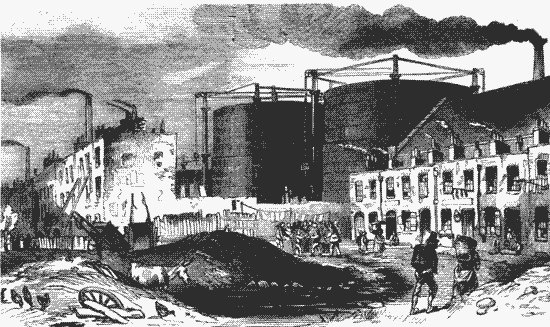
'Dark Satanic Mills
But it was also a time of the formation of Trade Unions and Working Class Cooperative societies, and due to the Combination Acts, which essentially outlawed any grouping of workers on a collective basis, they turned to underground activity. Artisans such as weavers, who were specialised in their trade, were slowly being undercut by the factory system, whereby machinery and cheap labour were destroying their means of subsistance. In response to this, we get the Luddite movement, which went about destroying machinery which threatened the weavers traditional way of life and trade. So, despite the massive displacement of people throughout this period, resistance to the Capitalists did occur, and under very unfavourable conditions.
E.P Thompson states as his aim for this massive work:
Its a great book, weighing in at around 900 pages, but the amount of research need to undertake a task of this size is phenomenal. It shows for one thing how the middle classes turned away from the most revolutionary working class agitation, and how workers of the period, most working 12 hour days, would come home and educate themselves. The book also shows how reactionary the Government was toward radicals, working class organisations and any form of organised dissent. During the French Revolutionary Wars, the Pitt Govt. suspended Habeas Corpus, organised 'Church and King' counter-riots, increased stamp tax to stop or stifle working class journals, and acted in a most barabic counter-revolutionary manner against the British Jacobin societies and workers combinations.
Incredible low wages, child labour, extreme poverty, unsanitary living conditions are all associated with this period, whilst the Capitalists who owned the factories and means of production raked in immense profits and wealth.
'Dark Satanic Mills
But it was also a time of the formation of Trade Unions and Working Class Cooperative societies, and due to the Combination Acts, which essentially outlawed any grouping of workers on a collective basis, they turned to underground activity. Artisans such as weavers, who were specialised in their trade, were slowly being undercut by the factory system, whereby machinery and cheap labour were destroying their means of subsistance. In response to this, we get the Luddite movement, which went about destroying machinery which threatened the weavers traditional way of life and trade. So, despite the massive displacement of people throughout this period, resistance to the Capitalists did occur, and under very unfavourable conditions.
E.P Thompson states as his aim for this massive work:
"I am seeking to rescue the poor stockinger, the Luddite cropper, the 'obsolete' hand-loom weaver, the 'Utopian' artisan, and even the deluded follower of Joanna Southcott, from the enormous condescension of posterity. Their crafts and traditions may have been dying. Their hostility to the new industrialism may have been backward-looking. Their communitarian ideals may have been fantasies. Their insurrectionary conspiracies may have been foolhardy. But they lived through these times of acute social disturbance, and we did not. Their aspirations were valid in terms of their own experience; and, if they were casualties of history, they remain, condemned in their own lives, as casualties".
Its a great book, weighing in at around 900 pages, but the amount of research need to undertake a task of this size is phenomenal. It shows for one thing how the middle classes turned away from the most revolutionary working class agitation, and how workers of the period, most working 12 hour days, would come home and educate themselves. The book also shows how reactionary the Government was toward radicals, working class organisations and any form of organised dissent. During the French Revolutionary Wars, the Pitt Govt. suspended Habeas Corpus, organised 'Church and King' counter-riots, increased stamp tax to stop or stifle working class journals, and acted in a most barabic counter-revolutionary manner against the British Jacobin societies and workers combinations.
'The Levelution is begun,
So I'll go home and get my gun.
And shoot the Duke of Wellington.'
posted by Kevin Sparrow at 3:08 pm


0 Comments:
Post a Comment
<< Home